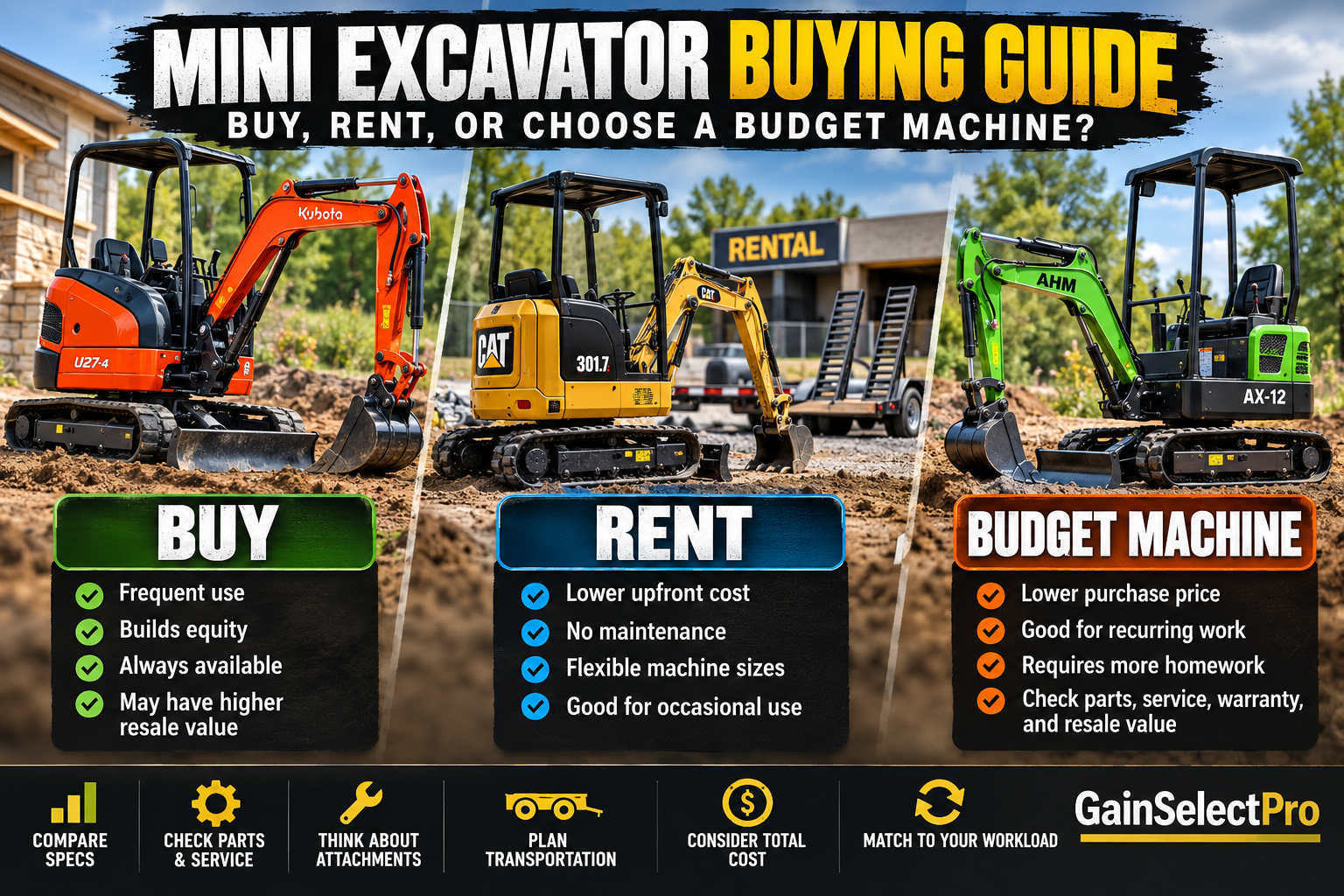
Choosing a mini excavator is not just about horsepower or digging depth. For a small contractor, the bigger question is whether owning one will save enough time, rental expense, and scheduling headaches to justify the investment.
A budget mini excavator can cost far less than a comparable machine from an established dealer brand—but purchase price is only part of the equation. Parts, service, downtime, attachments, transportation, warranty, and resale value can matter just as much.
This guide will help you decide whether it makes more sense to buy, rent, or consider a lower-cost mini excavator for the type of work you actually perform.
Affiliate Disclosure: GainSelectPro may earn a commission if you purchase through certain links in this article, at no additional cost to you.
Quick Decision: Buy or Rent?
Your Situation | Buy | Rent | Consider Budget Machine |
Frequent excavation/trenching | ✓ | ✓ | |
Occasional projects | ✓ | ||
Need equipment available anytime | ✓ | ✓ | |
Don't want maintenance/storage | ✓ |
The $10,000 Question: When Does Buying Beat Renting?
Renting a mini excavator can make sense when you only need one occasionally. But as rental days accumulate, the economics can change quickly.
The real question is not simply “Can I afford to buy one?” It is:
How many paid rental days would it take before those rental costs begin approaching the cost of owning a lower-priced machine?
For example, if a contractor spends $350 per rental day, the math looks like this:
10 rental days = $3,500
20 rental days = $7,000
30 rental days = $10,500
That calculation is intentionally simple. Delivery, pickup, taxes, fuel, insurance, maintenance, financing, storage, repairs and resale value can materially change the real cost on either side.
GainSelectPro Tip: Track how many days you actually needed an excavator during the last 12 months. Your own utilization may tell you more than any general rule about whether you should buy or rent.
Budget Mini Excavator vs. Established Dealer Brand
| What to Compare | Budget Mini Excavator | Established Dealer Brand |
| Purchase price | Generally lower | Generally higher |
| Dealer network | Verify carefully | Often more extensive |
| Parts availability | Verify before buying | Often well established |
| Resale market | May be less predictable | Often stronger |
| Service & support | Check warranty and response process | Dealer support may be available |
| Ownership question | Do the savings justify the added risk? | Does support justify the premium? |
AHM AX-12 vs. Bobcat E10: What Do the Numbers Show?
This comparison shows why lower-cost mini excavators deserve attention—but also why specifications alone should never determine the purchase.
The AHM AX-12 and Bobcat E10 occupy a similar compact working class, but their purchase prices are dramatically different. That makes them useful examples of the budget ownership vs. established dealer-brand decision.
| Specification | AHM AX-12 | Bobcat E10 |
| Listed price | $6,799.99* | |
| Horsepower | 13.5 HP | 10.2 HP |
| Operating weight | 2,227 lb | 2,593 lb |
| Max. dig depth | 73 in. | 72 in. |
| Bucket digging force | 2,585 lbf | 1,865 lbf |
| Current status | Sold out* | Check dealer/current availability |
Prices, specifications and availability can change. AHM AX-12 availability should be checked before purchasing.
Interested in a budget mini excavator? Check the current AHM AX-12 price and availability →
Don’t Compare Specs Alone
Horsepower, digging depth, weight, and digging force are easy to compare. The harder questions often determine whether a machine becomes a good investment or an expensive headache.
Before buying any mini excavator, check:
Parts availability — How quickly can common replacement parts be obtained?
Service — Who can repair the machine locally?
Warranty — What is covered, for how long, and who handles the claim?
Attachments — Are buckets, augers, thumbs, breakers, and other attachments readily available?
Transportation — Can your existing truck and trailer legally and safely transport the machine and attachments?
Resale value — What might the machine be worth when you eventually replace it?
GainSelectPro Tip: A lower purchase price can be attractive, but downtime has a price too. Compare the total ownership experience—not just the specifications on the product page.
One Jobsite, Several Equipment Decisions
A mini excavator may handle the digging, but many projects require several machines before the job is finished. Thinking about the entire workflow can help contractors avoid buying the wrong equipment—or renting something they already use frequently.
DIG → Mini Excavator
Trenches, drainage, utilities, excavation, and site preparation.
COMPACT → Plate Compactor
Compact base material, backfill, and prepared surfaces before the next stage of construction.
MIX → MudMixer
For projects where concrete or similar bagged materials need to be mixed efficiently on site.
CUT → Husqvarna K770 Power Cutter
Concrete, masonry, and other cutting applications depending on blade and configuration.
CORE → Core Drill
Create controlled openings through concrete and masonry for plumbing, electrical, HVAC, and other installations.
So, Should You Buy or Rent?
BUY if you use a mini excavator frequently enough that rental costs, scheduling, and repeated delivery charges are becoming a regular business expense.
RENT if excavation is occasional, your projects require different machine sizes, or you would rather avoid maintenance, storage, transportation, and repair responsibilities.
CONSIDER A BUDGET MACHINE if you have recurring work, limited capital, and are comfortable doing more homework on parts, service, warranty support, and resale value.
There is no universal answer. The best choice is the machine—or rental strategy—that produces the lowest practical cost while keeping your crews productive.
Explore AHM Mini Excavators
AHM offers several compact excavator configurations at prices below many established dealer-brand machines. Before purchasing, compare the model’s specifications, current availability, attachments, warranty, parts support, and shipping requirements with the work you actually perform.
Check current AHM mini excavators and availability →
Final Thoughts
A mini excavator can be one of the most useful machines on a small contractor’s jobsite—but only when the workload justifies ownership.
Before buying, look beyond horsepower and digging depth. Consider how often you will use the machine, what renting currently costs you, how you will transport it, where you will get parts and service, and what downtime could cost your business.
A lower-cost machine may make ownership possible much sooner. An established dealer brand may offer advantages in service, parts availability, and resale. Renting may still be the smartest choice when usage is limited.
The goal isn’t to own more equipment. The goal is to have the right equipment available at the lowest practical cost.